As a Parent, I Ask Myself: Does Project-Based Learning Really Work?
My kids attend a school that uses the Project-Based Learning (PBL) method, and to be honest, when they first started, I wasn’t entirely sure what to expect.
I had a general sense of what PBL was; students working on meaningful projects, solving real-world problems, building things together. It sounds promising and is definitely different from the structured, lecture-heavy classrooms I experienced as a student back in the late ’90s and early 2000s.
Instead of jumping to conclusions, I decided to observe and see how it would unfold. And what I’ve seen has left a lasting impression.
What I Noticed at Home
My kids started coming home from school with a different kind of energy. Instead of the usual “Nothing much” when I asked about their day, they had stories to tell. Not just about what they learned, but about what they did.
One time, they worked on a recycling project. Another time, they designed a rainwater harvesting system to help the school conserve water. They weren’t just memorizing facts; they were tackling real problems, collaborating with classmates, and learning how to think for themselves.
They asked better questions. They explained things with real understanding. They took pride in their work.
And as a parent, I started asking myself: Is this approach actually better for learning?
I Looked Into the Research
I came across a study published in Frontiers in Psychology that explored this exact question. Researchers Lu Zhang and Yan Ma reviewed 66 studies from the past 20 years to see how well project-based learning works compared to traditional teaching methods.
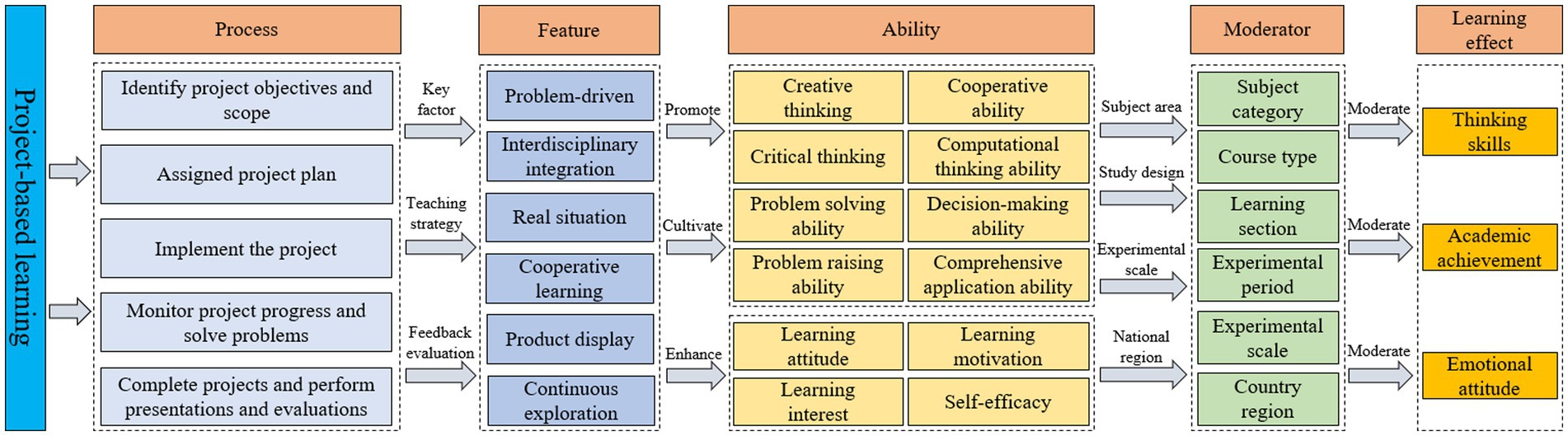
To explain how and why PBL works, the researchers developed a simple framework that outlines the key parts of the process; they are things like solving real-world problems, working in teams, and actively building knowledge. These elements, when combined, create a learning environment that’s more engaging and meaningful.
[
](https://www.frontiersin.org/files/Articles/1202728/fpsyg-14-1202728-HTML-r3/image_m/fpsyg-14-1202728-g004.jpg)*Theoretical framework for the impact of PBL on learning effects.*
*Theoretical)
Their conclusion? PBL works! And it works well. According to the study, project-based learning helps students in several important ways. It boosts academic performance, encourages deeper thinking, and increases motivation. But the benefits go beyond just getting better grades.
When It Works Best
The study also pointed out what makes PBL most effective. It works especially well when:
-
Students work in small groups (4 to 5 kids)
-
Teachers manage smaller class sizes
-
The subject is hands-on like science or technology
-
The project lasts between 9 and 18 weeks
-
It’s used in high school, though younger students benefit too
And interestingly, students in Southeast Asia showed the greatest gains from project-based learning, followed closely by those in West Asia.
What This Means for Parents Like Me
This research backed up what I already felt as a parent. My kids aren’t just learning better facts; they’re becoming better thinkers. They’re learning how to work with others, how to ask the right questions, how to stick with a challenge, and how to apply what they know in new ways.
They’re not just studying for a test. They’re learning for life. To me, that’s what school should be about.
Final Thoughts
Project-based learning might not be exactly what we parents grew up with, but maybe that’s the point. The world has changed, and so has the way our kids learn best.
Based on the research, and my own experience as a parent, I truly believe that project-based learning helps students grow in ways that matter; not just for school, but for the future.
If your child’s school is using PBL, ask them about their projects. Get involved. You might be surprised by what your child is capable of when they’re learning through doing, building, and solving.
Want to dig into the research yourself? Here’s the study I read:
Zhang, L., & Ma, Y. (2023). A study of the impact of project-based learning on student learning effects: A meta-analysis study. Frontiers in Psychology, 14, Article 1202728. https://doi.org/10.3389/fpsyg.2023.1202728